


When Your California Employer Misses the Final Pay Deadline: Your Rights and Next Steps
If your employer failed to hand you a final paycheck on time, California law may entitle you to significant penalties on top of your unpaid wages. Under California Labor Code § 202, employees who quit without providing at least 72 hours’ notice must receive all earned wages, including accrued vacation, within 72 hours of quitting. Those who give at least 72 hours’ notice are entitled to final pay at the time of quitting. If you were fired or laid off, California Labor Code § 201 requires immediate payment at discharge. When employers miss these deadlines, consequences can add up quickly, especially for Los Angeles workers who depend on timely pay for rent, transportation, and daily expenses.
If your employer missed your final pay deadline, RD Law Group APC can help you understand your options. Call (424) 535-1500 or reach out online to discuss your situation.
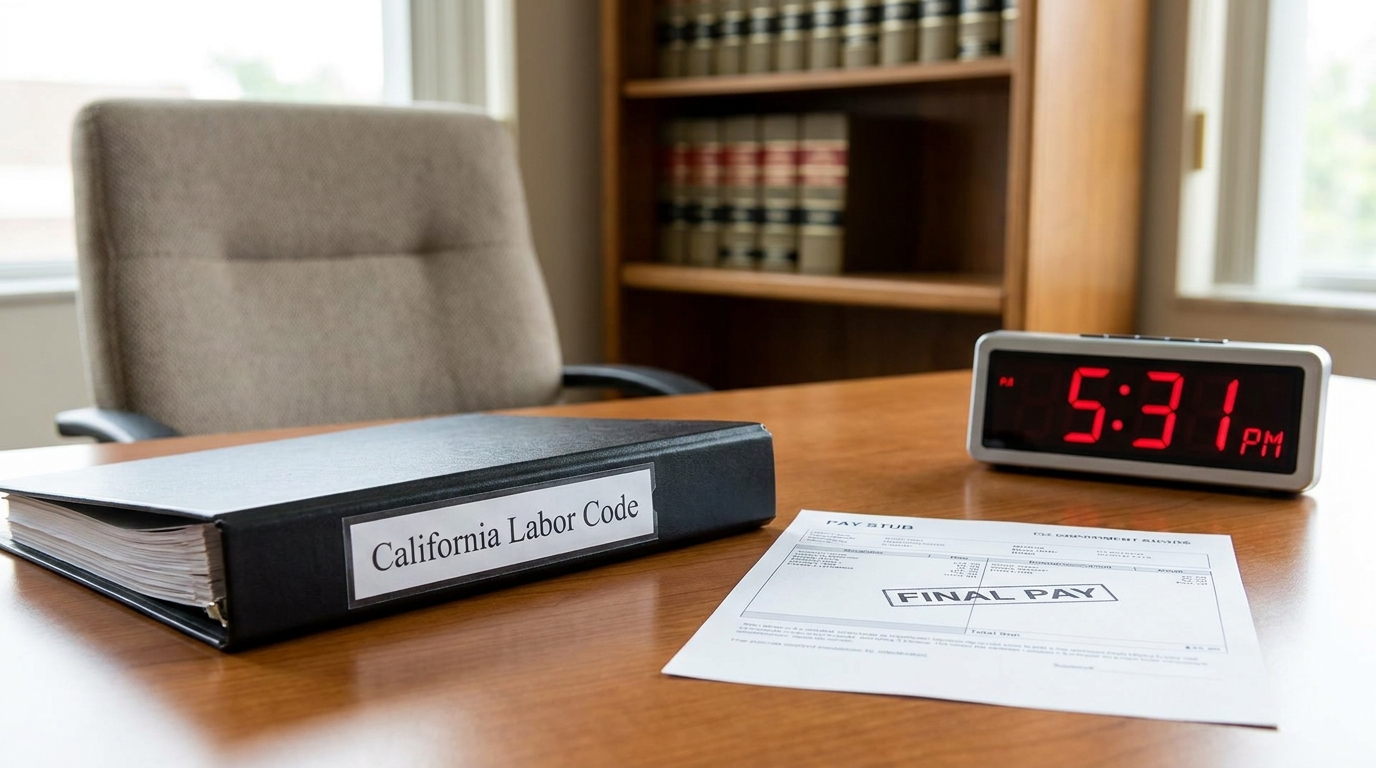
Understanding the California Final Pay 72 Hours Weekend Rule
California’s final paycheck deadlines depend on whether you resigned or were terminated. This distinction matters because voluntary resignation and involuntary termination trigger different timing rules under California law. Here is how the timelines break down:
| Situation | Final Pay Deadline |
|---|---|
| Employee is fired or laid off | Immediately at time of termination |
| Employee quits with 72+ hours’ notice | At the time of quitting |
| Employee quits without 72 hours’ notice | Within 72 hours of quitting |
The 72-hour window applies specifically to employees who quit without advance notice. If you gave at least 72 hours’ notice before your last day, your employer should have had your final paycheck ready on your last day. Many Los Angeles workers are unaware of these distinctions and may not realize their employer already violated the law.
💡 Pro Tip: Keep a written record of when and how you gave notice of resignation. A text message, email, or letter with a timestamp can prove whether you provided the required 72 hours’ notice, which directly affects your final pay deadline.
What Happens When an Employer Misses the Deadline
Late final pay in California can trigger waiting time penalties under Labor Code § 203. The waiting time penalty equals the employee’s daily rate of pay for each day wages remain unpaid, up to a maximum of 30 calendar days. For example, if you earned $200 per day and your employer was 30 or more days late, you could be owed up to $6,000 in penalties alone, on top of actual unpaid wages.
These penalties begin accruing immediately after the deadline passes. The clock starts the day after your wages were due. The California Court of Appeal in Mamika v. Barca (1998) established that the daily rate of pay serves as the measure for penalty calculations. Penalties will not be awarded if the employee avoids or refuses to receive payment of wages due.
💡 Pro Tip: Calculate your own estimated waiting time penalties by dividing your regular weekly pay by the number of days you work per week. Multiply that daily rate by the number of days your pay is late (up to 30). This gives you a rough idea of what you may be owed.
When the Penalty Clock Starts Ticking
The penalty period runs in calendar days, not business days. Weekends and holidays count toward the 30-day maximum. If your employer owes you a final paycheck and the California final pay 72 hours weekend period passes without payment, every additional day adds to your potential penalty amount.
The "Good Faith Dispute" Defense and What It Means for You
Employers sometimes try to avoid waiting time penalties by claiming a "good faith dispute" over wages owed. Under Labor Code § 203 and Title 8, California Code of Regulations § 13520, a good faith dispute exists when an employer presents a defense based in law or fact that, if successful, would preclude any recovery by the employee. However, a defense that is unsupported by evidence, unreasonable, or asserted in bad faith will not qualify. The fact that a defense is ultimately unsuccessful does not by itself preclude a finding that the dispute was made in good faith.
Even when a dispute exists, your employer must still pay the undisputed portion of your wages on time. Under Labor Code § 206, if the employer fails to pay what is undisputed, the good faith defense is defeated entirely. This means your employer cannot withhold your entire paycheck simply because there is disagreement over a portion of it.
💡 Pro Tip: If your employer claims they owe you less than you believe, document the difference. The fact that they withheld undisputed amounts can strengthen your case and eliminate their primary defense against waiting time penalties.
What Counts as "Willful" Under the Law
Under Labor Code § 203, "willful" does not require malicious intent or bad faith, it simply means the employer intentionally failed to pay wages that were due. A good faith dispute that wages were owed may preclude a finding that the failure was willful. But the bar for a legitimate good faith dispute is meaningful, the defense must rest on actual legal or factual grounds rather than a simple desire to delay payment.
How to File a Wage Claim in Los Angeles
If your employer has not paid your final wages, you can file a wage claim with the California Division of Labor Standards Enforcement (DLSE). The DLSE process provides an administrative path to recover unpaid wages, including penalties for delays in providing a final paycheck.
After you file your claim, it will be assigned to a Deputy Labor Commissioner who will make an initial decision. The Commissioner may dismiss the claim, assign it to a settlement conference, or schedule it for a hearing. Processing times vary and may take several months depending on the DLSE office’s caseload.
What to Expect at the Hearing
The wage claim hearing process is relatively informal compared to a court trial. The hearing results in a written decision by the Labor Commissioner known as an Order, Decision, or Award (ODA). Under Labor Code § 98.2, either party has 10 days after service of the ODA to file an appeal to California Superior Court, though an additional five days are added when the ODA is served by mail, which is the typical method.
💡 Pro Tip: Gather your pay stubs, time records, resignation or termination letter, and any written communications with your employer before filing your claim. Strong documentation can make a significant difference in the outcome.
Key Steps to Protect Your Final Pay Rights as an Employee
Taking action early can help preserve your ability to recover unpaid final wages in LA. Consider the following steps if your employer missed your final paycheck deadline:
- Document the date of your termination or resignation and how you delivered notice
- Save all pay stubs, direct deposit records, and written communications about your pay
- Note whether your employer paid any portion of your wages or withheld everything
- Calculate your daily wage rate to estimate potential waiting time penalties
- File a wage claim with the DLSE or consult an attorney about your options
California’s final paycheck law protects employees regardless of whether they were fired for cause, laid off, or quit voluntarily. The rules apply to hourly, salaried, and commission-based workers, though certain industries such as motion picture production and oil drilling may have modified timelines under Labor Code §§ 201.5 and 201.7, while seasonal agricultural workers in the curing, canning, or drying of perishable fruit, fish, or vegetables have a modified timeline under Labor Code § 201 (up to 72 hours after layoff).
💡 Pro Tip: Do not wait to take action. While California law does not impose an extremely short statute of limitations on wage claims, the sooner you file, the easier it may be to gather evidence and hold your employer accountable.
Frequently Asked Questions
1. Does the California final pay 72 hours weekend count toward the deadline?
Yes. The 72-hour period under Labor Code § 202 runs in calendar time, including weekends and holidays. If you quit on a Friday afternoon without prior notice, your employer generally must pay you by Monday afternoon. Waiting time penalties also accrue on calendar days.
2. What if my employer says they mailed my final paycheck?
Under Labor Code § 202, if an employee who quits without notice requests that final wages be mailed to a designated address, the date of mailing is considered the date of payment. However, if the employer unilaterally chose to mail the check without such a request, the employer may still face waiting time penalties if the check was not received by the statutory deadline.
3. Can I file a wage claim if I was an independent contractor?
The DLSE handles claims from employees, not independent contractors. However, if you were misclassified as an independent contractor when you should have been treated as an employee, you may still have a valid claim.
4. How much can I recover in waiting time penalties?
Under Labor Code § 203, the penalty equals your daily rate of pay for each day your final wages remain unpaid, capped at 30 days’ pay. This amount is in addition to the actual unpaid wages owed.
5. Do I need a lawyer to file a wage claim with the DLSE?
You are not required to have an attorney to file a wage claim. However, having legal guidance from a wage claim attorney in Los Angeles can help you navigate the process, calculate penalties accurately, and present a stronger case.
Take Action to Recover Your Unpaid Final Wages
Missing the final paycheck deadline is not just an inconvenience. It is a violation of California labor law that may entitle you to substantial penalties. Whether you quit or were terminated, the law sets clear timelines your employer must follow. If those deadlines passed without payment, you have options.
If you are dealing with unpaid final wages in Los Angeles, RD Law Group APC is ready to help you pursue the compensation you deserve. Call (424) 535-1500 or contact us today to get started.


