

Key Takeaways
Key Takeaways: Many 2026 layoffs are described as "AI restructuring," but California workers age 40 and older may still be able to challenge how they were selected under both the federal ADEA and California’s FEHA. An attorney usually tests a layoff for age bias in three steps: identifying the decisional unit, comparing selection rates by age, and checking whether the AI tool’s inputs, such as "adaptability" or salary band, stood in for age. Under Meacham v. Knolls Atomic Power Laboratory, once a disparate-impact case is made, the employer must prove its criteria were reasonable factors other than age. California law generally does not allow retirement eligibility as a basis for choosing older workers. Higher earners should also check whether a severance release waives double-trigger acceleration after termination, pending bonuses, or commissions. Some earned wages cannot be waived at all. OWBPA disclosures, California’s five-business-day attorney-consultation notice, and federal review periods can give you leverage, so preserve your documents and avoid signing early. A layoff is not unlawful on its own, and every outcome depends on the specific facts.
Across Los Angeles, many laid-off professionals are hearing the same explanation: their roles were "automated," "consolidated," or "realigned around AI." Some of these reductions may be genuine business decisions. Others may fall hard on employees over 40, especially longer-tenured engineers, managers, and sales leaders with high pay and substantial unvested equity. If you received a severance package, what happens in the next few weeks can shape both any age discrimination claim and how much compensation you keep. This article explains how an attorney generally tests a layoff selection for age bias, and why the fine print on your equity matters as much as the reason you were given.

The Legal Framework Behind Age Bias in a Reduction in Force
Two bodies of law generally govern layoff selection age discrimination in California: the federal Age Discrimination in Employment Act (ADEA) and California’s Fair Employment and Housing Act (FEHA). Both protect workers age 40 and older, but they have different coverage thresholds (generally 20 or more employees under the ADEA and 5 or more under FEHA), procedures, remedies, and case law. A claim that is weak under one can sometimes be stronger under the other, so an attorney will usually evaluate both.
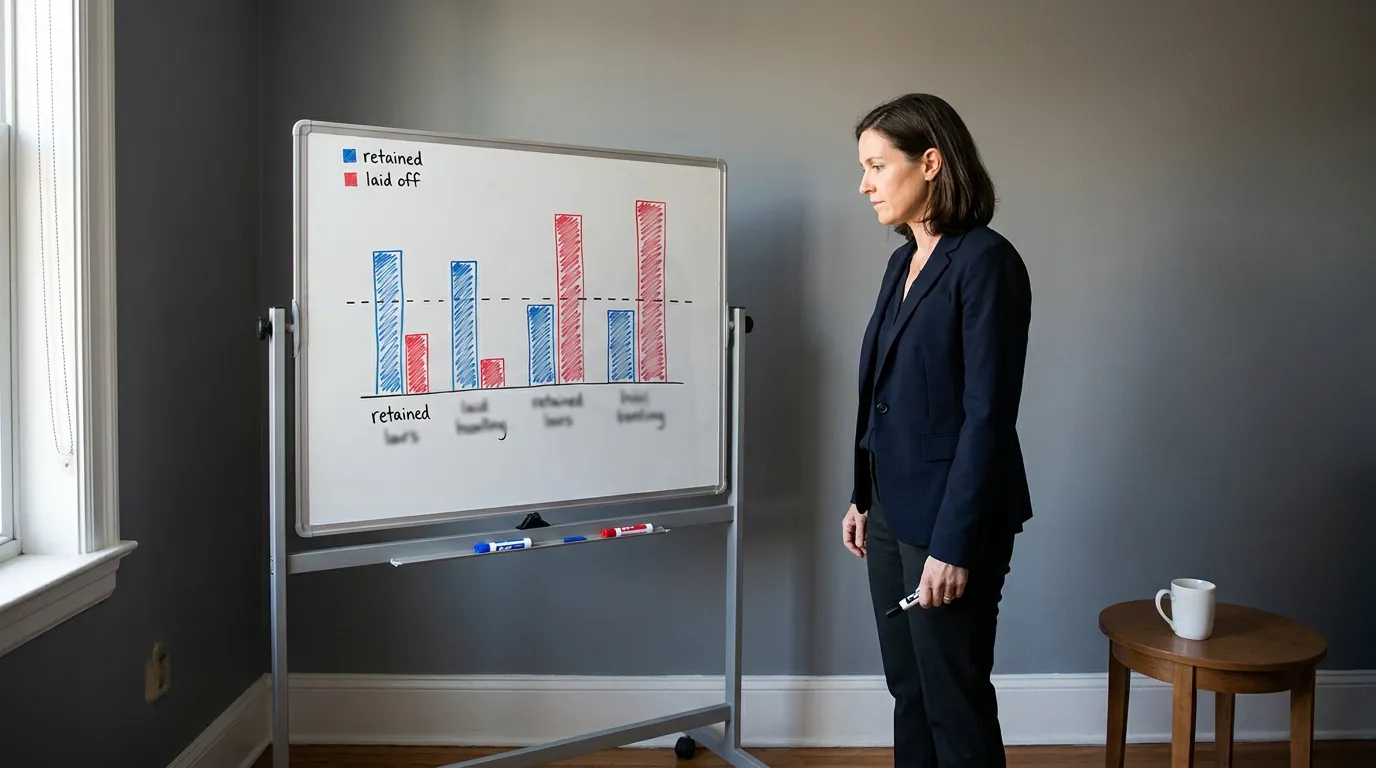
The leading federal case is a layoff case. In Meacham v. Knolls Atomic Power Laboratory (2008), older employees challenged a 1996 workforce reduction in which 30 of the 31 people laid off were at least 40. Managers had ranked employees on "performance," "flexibility," and "critical skills," subjective criteria that can reappear today as inputs to an algorithm. The plaintiffs relied on statistical evidence of the age disparity.
The Supreme Court’s holding shifted real weight onto employers. As the Meacham majority opinion explains, the "reasonable factors other than age" (RFOA) exemption in ADEA §4(f)(1) is an affirmative defense. The employer carries both the burden of producing evidence and the burden of persuading the factfinder. Building on Smith v. City of Jackson (2005), the opinion confirms that an ADEA claim can proceed on a disparate-impact theory, which does not require proof of intent. Employees must still identify the specific practice that caused the disparity, and the RFOA defense is generally easier for employers to meet than "business necessity."
California’s statutes add further protection. The FEHA unlawful practices provisions include Government Code §12942, which generally requires employers to let employees keep working past a private pension plan’s retirement date if they can still do the job. It allows compulsory retirement only in narrow situations, such as certain high-level executives over 65 who receive substantial retirement benefits. Government Code §12941 also states that using salary as the basis for differentiating between employees when terminating employment may be found to constitute age discrimination if it adversely impacts older workers as a group, and that the disparate impact theory of proof may be used in age discrimination claims. In practice, "they were near retirement anyway" is generally not a lawful basis for choosing older workers.
A Los Angeles Scenario: The Principal Engineer and the Algorithm
Consider a hypothetical: a 56-year-old principal engineer at a Santa Monica software company earning about $310,000 a year in salary, bonus, and restricted stock units. Three weeks after her company announced an "AI-first reorganization," she was let go along with 40 others. The company said a "skills-mapping tool" had identified redundant roles. Most of the people she knew who were gone were over 45, while several younger, less experienced colleagues stayed on.
The severance offer gave her twelve weeks of pay in exchange for a broad release. It said nothing about her unvested RSUs. Her offer letter referred to acceleration if she was terminated after a change in control, and the company had been acquired eight months earlier. Her annual bonus was scheduled to pay out six weeks after her last day. She may have both a potential age-bias claim and significant money at stake, though whether acceleration applies depends on whether her termination fell within the plan’s protection window and met its definitions.
How an Attorney Tests AI-Driven Layoff Selection for Age Bias
An attorney generally starts with the numbers and then looks at the criteria behind them. This matches the Meacham framework: a statistical disparity tied to a specific practice may support a disparate-impact theory, and the employer must then prove its factors were reasonable factors other than age. Evidence that the employer intended to target older workers may support a separate disparate-treatment claim.
Step One: Define the Decisional Unit
The first question is who was actually considered for the layoff. Statistics mean little until you know the pool, whether a team, a department, or the whole company. When a severance agreement asks employees over 40 to waive federal age claims in a group layoff, the Older Workers Benefit Protection Act generally requires the employer to disclose the decisional unit, the eligibility factors and time limits, and the job titles and ages of those selected and not selected. That disclosure is often the most valuable early evidence. A defective disclosure generally affects only the validity of the federal ADEA waiver, not whether the layoff itself was discriminatory.
Step Two: Compare Outcomes by Age
Next, an attorney compares selection rates for workers over 40 against those for younger workers in the same pool. A lopsided result does not prove discrimination on its own. Courts may consider sample size, statistical significance, how job categories were grouped, and legitimate explanations. A pattern like the one in Meacham, however, may justify a closer look.
Step Three: Examine the Tool and Its Inputs
AI tools are only as neutral as the data they use. Criteria such as "adaptability," "future skills," years since last promotion, or salary band can act as proxies for age. The California Civil Rights Council’s regulations on automated-decision systems, which took effect on October 1, 2025, confirm that FEHA applies to employment decisions made with these tools, including decisions beyond hiring such as promotion and evaluation, for California employers with five or more employees. Commentators have argued that litigation can help curb algorithmic discrimination, and employer groups, including SHRM and its California affiliate, submitted comments while those regulations were being developed. How they apply to a particular layoff depends on the facts.
Evidence worth preserving generally includes:
- The termination letter, severance agreement, and any OWBPA age disclosure attachment
- Performance reviews, rankings, and recent compensation or promotion history
- Company announcements describing the "AI restructuring" or selection method
- Names and approximate ages of colleagues who were retained or let go
- Offer letters, equity grant agreements, bonus plans, and commission statements
- Any age-related comments, such as "fresh perspective" or "digital natives," with dates and witnesses
Suspicious timing can strengthen a claim. For example, timing matters if you were chosen shortly after returning from protected medical leave or after raising a legal compliance concern, which may also support separate leave or retaliation claims. Timing alone is rarely enough, but combined with statistics and questionable criteria, it may help establish causation. For a broader overview, see our guide on whether you can be fired for being over 40 in Los Angeles.
Why Double-Trigger Acceleration After Termination Changes Severance Math
For older tech workers who have been laid off, equity is often the largest dollar figure on the table. A double-trigger provision typically accelerates vesting only when two events happen: a change in control, such as an acquisition, and a qualifying termination within a set window. Whether double-trigger acceleration after termination applies to you depends on the exact wording of your grant and plan documents, including definitions like "cause," "good reason," and the length of the protection window. Some plans also require a signed release before acceleration takes effect.
Many severance agreements start from standard templates, and the real value usually comes from negotiation leverage. A general release could be read to waive disputed acceleration, bonus, or commission claims. Under California Labor Code §206.5, however, a release generally cannot waive wages that are undisputedly owed, and earned commissions or bonuses may count as wages. A credible age-bias theory, an incomplete OWBPA disclosure, or a bonus days or weeks from vesting may give you reasons to ask for more cash, accelerated equity, or an extended exercise period. Outcomes vary, and no result can be assured.
California’s Severance Release Rules
California regulates how a severance release can be presented. Government Code §12964.5 does not ban general releases, but it requires that they be otherwise lawful, including limits on restricting disclosure of information about unlawful workplace conduct. It also requires the employer to notify you of your right to consult an attorney and give you at least five business days to do so, although you may sign sooner. For a release that waives federal age claims, the OWBPA requires at least 21 days to consider the agreement, or 45 days in a group layoff, plus a seven-day revocation window. Signing early may give up leverage.
Deadlines and Common Pitfalls
Deadlines vary by claim and can be unforgiving. FEHA claims generally require an administrative complaint with the California Civil Rights Department, usually within three years, before suing. Federal ADEA claims generally require an EEOC charge within 300 days in California. Contract claims for equity or bonuses follow separate statutes of limitations, generally four years for written contracts.
The most common mistake is treating the layoff as unfair rather than unlawful. Employment in California is presumed at-will, so being laid off, even badly, is not illegal by itself unless a contract or statute limits the employer. A viable claim generally requires a link to age or another protected characteristic, or to protected activity, supported by evidence such as statistics, criteria, comments, or timing.
How Does This Impact Me?
Does the Meacham Decision Help My California Claim?
It may, depending on your facts. Meacham is federal precedent under the ADEA and places the RFOA burden on the employer. FEHA is a separate state law with its own case law, and California courts may look to federal decisions without being bound by them.
Can I Challenge a Layoff Chosen by an AI Tool?
Possibly. Automated selection does not shield an employer from disparate-impact scrutiny. The key questions are whether the results fell disproportionately on workers over 40 and whether the criteria can be defended as reasonable non-age factors.
Will Signing the Severance Agreement End My Claims?
In many cases, a valid release waives most claims. Some rights cannot be waived, such as undisputed earned wages and the right to file an EEOC charge. California requires notice of your right to consult an attorney and at least five business days to do so, and federal age waivers carry additional requirements. A release that fails them may be open to challenge.
What If My Bonus or Equity Was About to Vest?
Termination shortly before a vesting or payout date can be a significant negotiation point. Your plan documents generally control, including any double-trigger terms, although earned bonuses may also be protected as wages. Gather them right away.
What Should I Do First?
Preserve your documents, write down a timeline, and avoid signing anything under time pressure. Then have the agreement and your selection data reviewed well before any deadline.
Protecting Your Rights and Your Compensation After an AI Layoff
The 2026 wave of AI restructuring layoffs may be presented as neutral technology, but the law still asks who was selected and why. Federal precedent requires employers to prove that age-skewed criteria were reasonable factors other than age. California adds limits on retirement- and salary-based decisions, rules for automated-decision systems, and procedural protections for severance releases. For high earners, the equity, bonus, and commission terms in a separation package often determine what is really at stake.
If you were over 40, laid off in Los Angeles, and handed a severance agreement, an informed review may clarify both your potential claims and your negotiation leverage. RD Law Group APC reviews these situations for California employees after termination. You can speak with a double-trigger acceleration after termination lawyer by calling (424) 535-1500, or contact us today to schedule a confidential consultation. This article is general information, not legal advice, and results depend on the specific facts.


